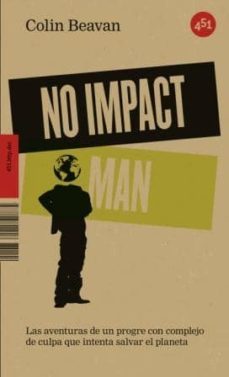
In the growing debate over eco-friendly living, it seems that everything is as bad as everything else. Do you do more harm by living in the country or the city? Is it better to drive a thousand miles or take an airplane?In NO IMPACT MAN, Colin Beavan tells the extraordinary story of his attempt to find some answers - by living for one year in New York City (with his wife and young daughter) without leaving any net impact on the environment. His family cut out all driving and flying, used no air conditioning, no television, no toilets. . . They went from making a few concessions to becoming eco-extremists. The goal? To determine what works and what doesn''t, and to fashion a truly ''eco-effective'' way of life.Beavan''s radical experiment makes for an unforgettable and humorous memoir in an attempt to answer perhaps the most important question of all: What is the sufficient individual effort that it would take to save the planet? And what is stopping us?
Un año en Nueva York sin electricidad ni papel higiénico.
Un progre con complejo de culpa estalla, se niega a consumir nada envasado en plástico, se convierte a lo orgánico, se vuelve un nazi de la
Aunque la frecuente atención que dedican los medios a la identificación de delincuentes mediante el ADN da la impresión de que la dactiloscopia ha quedado anclada en los tiempos de Sherlock Holmes, las estadisticas de ambas tecnicas cuentan una historia diferente. Hasta marzo de 2000, el departamento de policia de la ciudad de Nueva York habia conseguido, con la tecnica del ADN, un total de 200 identificaciones de sospechosos. En cambio, en 1999, en un solo año, habia efectuado 1.117 identificaciones a partir de huellas halladas en el lugar de un crimen, seis veces mas que las logradas con ADN en toda la historia del departamento.(COLIN BEAVAN) Desde las pinturas rupestres, la huella de la mano siempre ha sido un signo identificador de la humanidad. Ya en el 600 a.C. chinos y japoneses la utilizaban para firmar contratos, y mas de mil trescientos años despues, en 1859, un gobernador ingles de un distrito de Bengala incorporo esta aplicacion a documentos oficiales. Las sociedades industrializadas necesitaban cada vez mas medios de identificacion duraderos, objetivos y fiables, y el interes de algunos cientificos por las huellas dactilares, en principio sin proposito practico, sento las bases para una nuevo sistema de control cuya eficacia en la investigacion criminal acabaria siendo demostrada. Pero el camino hacia esta demostracion fue largo y dificil, pues a la policia y a los jueces les costaba creer que la simple marca de un dedo pudiera ser una prueba irrefutable. Huellas dactilares es la fascinante reconstruccion de la vida y los esfuerzos de los pioneros de la nueva tecnica dactiloscopica, de sus batallas cientificas y legales, y de los primeros casos criminales en que intervinieron.
This edition does not include illustrations. A fascinating exploration into the history of science and crime. In the tradition of Fermats Last Theorem, FINGERPRINTS is the story of the race to discover the secrets trapped in the whorls and arches found on the palm of ones hand. In 1905 an elderly couple were found murdered in their shop in Deptford, London. The only evidence at the scene of the crime was a sweaty fingerprint on a cashbox. Was it possible that a single fingerprint could be enough to lead to a conviction? Could the pattern of these tracks hold the secrets of the science of identification? Through the story of three brilliant men: William Herschel, a colonial administrator in Indian, Henry Faulds, a missionary in Japan and Charles Darwins cousin, Francis Galton, the extraordinary story of the history of fingerprinting is revealed. It is a story of intellectual skulduggery and scientific brilliance. Packed with an extraordinary cast of individuals whose scientific breakthroughs helped solve one of the most brutal murders in English history and shape our understanding of identity forever.
In the growing debate over eco-friendly living, it seems that everything is as bad as everything else. Do you do more harm by living in the country or the city? Is it better to drive a thousand miles or take an airplane? In NO IMPACT MAN, Colin Beavan tells the extraordinary story of his attempt to find some answers - by living for one year in New York City (with his wife and young daughter) without leaving any net impact on the environment. His family cut out all driving and flying, used no air conditioning, no television, no toilets. . .They went from making a few concessions to becoming eco-extremists. The goal? To determine what works and what doesnt, and to fashion a truly eco-effective way of life. Beavans radical experiment makes for an unforgettable and humorous memoir in an attempt to answer perhaps the most important question of all: What is the sufficient individual effort that it would take to save the planet? And what is stopping us?
A thrilling account of one of the most important covert operations of World War II In 1943, less than a year before D-Day, nearly three hundred American, British, and French soldiersshadow warriorsparachuted deep behind enemy lines in France as part of the covert Operation Jedburgh. Working with the beleaguered French Resistance, the "Jeds" launched a stunningly effective guerrilla campaign against the Germans in preparation for the Normandy invasion. Colin Beavan, whose grandfather helped direct Operation Jedburgh for the Office of Strategic Services, draws on scores of interviews with the surviving Jeds and their families to tell the thrilling story of the rowdy daredevils who carried out Americas first specialforces missionsforever changing the way Americans wage war.