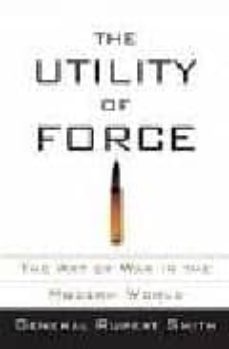
"War no longer exists," writes General Sir Rupert Smith, powerfully reminding us that the clash of mass national armies--the system of war since Napoleon--will never occur again. Instead, he argues in this timely book, we must be prepared to adapt tactics to each conflict, or lose the ability to protect ourselves and our way of life. General Smith draws on his vast experience as a commander in the 1991 Gulf War, in Bosnia, Kosovo and Northern Ireland, to give us a probing analysis of modern war and to call for radically new military thinking. Why, he asks, do we use armed force to solve our political problems? And how is it that our armies can win battles but fail to solve the problems? From Iraq to the Balkans, and from Afghanistan to Chechnya, Smith charts a stream of armed interventions that have failed to deliver on promises of resolution. He demonstrates why today''s conflicts must be understood as intertwined political and military events. He makes clear why the current one-size-fits-all model of total war, fought out on battlefields, that politicians still cling to must be abandoned in favor of new strategies that take into account the fact that wars are now fought among civilian populations. And he offers a compelling new model for how to fight these battles--and secure our world. Clear, incisive and provocative, "The Utility of Force" will fundamentally change the way we understand war.
From a highly decorated general, a brilliant new way of understanding war and its role in the twenty-first century. Drawing on his vast experience as a commander during the first Gulf War, and in Bosnia, Kosovo, and Northern Ireland, General Rupert Smith gives us a probing analysis of modern war. He demonstrates why todays conflicts must be understood as intertwined political and military events, and makes clear why the current model of total war has failed in Iraq, Afghanistan, and other recent campaigns. Smith offers a compelling contemporary vision for how to secure our world and the consequences of ignoring the new, shifting face of war.
Rupert Smith brings together his long and relevant experience of command in some of the more prickly theatres of conflict in our time in lucid writing to put through the message that the nature of war has changed irrevocably. And the armed forces too have to be reformed and thus prepared for the new conflicts
A stinging satire of tell-all showbiz memoirs starring a self-deluded gay icon who has managed to ride every pop culture trend of the last forty years.Marc LeJeune has had a remarkable career in the entertainment business. Despite the carping of critics, cruel twists of fate, and the treachery of former friends who were blind to his exceptional dramatic and musical talents, he has remained true to his unique artistic vision. From his early days as the face of Swinging London, to the late 1960s avant garde theater scene, through the sexually liberated cinema of the 1970s, to his current status as a much-loved household name and TV favorite, he tells all in this, his own astonishing story.Through this fabulous parody of the showbiz confession, Rupert Smith has created a witty and scathing satire of popular culture and entertainment over the last forty years. Marc LeJeune is a brilliant comic creation, inspired by Smiths many years of interviewing celebrities for Time Out and writing about showbiz in The Guardian (U.K.).
Mpho Mamela, a young accountant at a coal mine in the Middelburg coalfields of South Africa is killed one night when he gets caught in the rollers of a conveyor belt. He is mangled beyond recognition. There will be an official State enquiry into his death, by the Inspectorate of Mining. Stephen Wakefield, the in-house lawyer and a director of the company, begins preparing for the enquiry, but he struggles to understand what happened - Mamela should not have been anywhere near the place he was killed. Bit by bit, Stephens investigation uncovers a story far removed from a simple workplace accident. A web of deception and massive fraud is unveiled; fraud perpetrated by a person who publicly insists on high standards of morality and honesty. It becomes clear to Stephen that Mamela had tried to blackmail the guilty party to help his lover, who is in prison for attempting to steal a trifling amount from the mining company. When the killer learns that his actions are about to be exposed, Stephen realises that his own life is now in danger...
UPDATED WITH TWO NEW CHAPTERSOne of the most provocative and startling books ever written by a British commander ... an update of the two great thinkers on war and peace, Clausewitz and Sun Tsu, for our time ... it is for anyone interested in the well-being of our world Robert Fox, Evening StandardWhy do we try to use military force to solve our political problems? And why, when our forces win the military battles does this still fail to solve those problems? It is because the force lacks utility. From Iraq to the Balkans, and from Afghanistan to Chechneya, over the past fifteen years there has been a steady stream of military interventions that have not delivered on their promise for peace, or even political resolution. The Utility of Force explains this anomaly at the heart of our current international system.Britains outstanding soldier of modern times ... a book that will assure his reputation as a serious and original thinker among soldiers and strategists Sir John Keegan, Daily TelegraphIt is hard to overstate the devastating nature of this book as an indictment of almost everything the West has done in recent years, and is doing today Sir Max Hastings, Sunday Telegraph