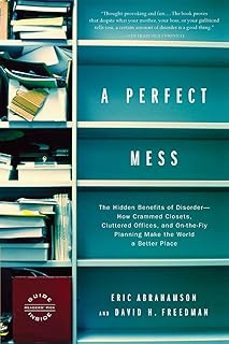
How Crammed Cupboards, Cluttered Offices, and Off-the-Cuff Planning make the World a Better Place.Like the bestselling Freakonomics or Blink, here is a book that combines a professors expertise with stories from everyday life to provide a striking new view of how our world works. Ever since Einsteins study of Brownian Motion, scientists have understood that a little disorder actually makes systems more effective. But most people still shun disorder, or suffer guilt over the mess they cant avoid. No longer! With a spectacular array of anecdotes and case studies of the useful role mess can play, here is an antidote to the accepted wisdom that tight schedules, neatness and consistency are the keys to success. Drawing on examples from business, parenting, cooking, the war on terrorism, retail and even the meteoric career of Arnold Schwarzenegger, co-authors Abrahamson and Freedman demonstrate that moderately messy systems use resources more efficiently, yield better solutions and are harder to break than neat ones. A PERFECT MESS will help readers assess what the right amount of disorder is for a given system, and how to apply these ideas on to a large scale - government or society - and on a small scale - in your attic, kitchen or office. A PERFECT MESS will forever change the way we think about those unruly heaps of paper on our desks.
Touting the benefits of disorder, chaos, and mess, a groundbreaking study explains how and why a little disorder actually makes systems more effective, citing examples from business, cooking, parenting, politics, and other fields to demonstrate that the right amount of disorder yields better solutions, uses resources more efficiently, and is more durable.
La mayoría de las personas rehuyen del desorden o siente culpa por no poder evitarlo, aunque el mundo científico ha comprobado que con una pequeña dosis de desorden la vida puede ser más fácil de vivir y mas interesante. En Elogio del desorden, los autores demuestran a traves de una gran cantidad de ejemplos reales que la obsesion por el orden tiene muchos menos beneficios de lo que creemos. Por el contrario, los casos analizados por Abrahamson y Freedman en los ambitos empresarial, politico, personal, domestico, economico y urbano indican que los sistemas moderadamente caoticos hacen un empleo mas eficiente de los recursos y logran mejores resultados que los ordenados. ¿Hasta donde llegaremos en nuestro afan por ordenarlo todo: las ciudades, las empresas, los gobiernos, las agendas, el pensamiento? Este libro tal vez nos lleve a descubrir que la busqueda constante del orden no siempre es el mejor camino.