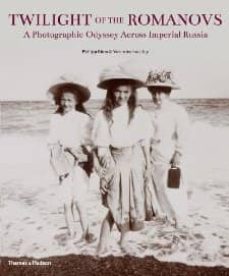
The lives of the tsars and their subjects from 1855 to 1918, told through rare archival photographs The Russian Empire was among the most mysterious of the worlds great powers, profoundly torn between a rural population living almost medieval lives and industrial and social change in the cities. The tsars gigantic realm struggled with the advent of modernity and with its own internal contradictions between Asia and Europe, faith and science, different ethnic groups, and the divergent interests of the aristocracy, the middle classes, the urban workers, and the rural poor: a continent of contradictions from abject poverty to fairy-tale wealth captured by authors from Tolstoy to Chekhov, from Gogol to Gorky. Twilight of the Romanovs opens a door into the world of pre-revolutionary Russia using original photographs taken during the last decades of Romanov rule. They include remarkable color images created using an early three-color-plate technique that brings the remote past to life. Our companions on this journey include the Scottish photographer William Carrick, Americans George Kennan and Murray Howe, the German-Russian Carl Bulla, Sergey Produkin-Gorsky, and the writers Leonid Andreyev and Anton Chekhov, together with many anonymous others. These photographs are snapshots of a vanished world, yet they reveal a surprising continuity: despite the subsequent revolution, faces, buildings, and landscapes still resonate with those who see them a century and more later. 360 illustrations, 114 in color
The groundbreaking biography of one of the most progressive, influential and entertaining women of the seventeenth century, Christina Alexandra, Queen of Sweden. In 1654, to the astonishment and dismay of her court, Christina Alexandra announced her abdication in favour of her cousin, Charles. Instrumental in bringing the Thirty Years War to a close at the age of 22, Christina had become one of the most powerful monarchs in Europe. She had also become notorious for her extravagant lifestyle. Leaving the narrow confines of her homeland behind her, Christina cut a remarkable path across Europe. She acted as mediator in the Franco-Spanish War and, in return for financial support, was received into the Roman Catholic Church despite the fierce condemnation of her protestant countrymen. Christina settled in Rome at the luxurious Palazzo Farnese where she established a lavish salon for Romes artists and intellectuals. More than once she was forced to leave Rome while one scandal or another died down; she was painted a lesbian, a prostitute and even a hermaphrodite. Her most impassioned affair was with a well-connected Cardinal. Later, when financial support from the Pope and the Spanish crown dried up, Christina began to court French favour, eventually even plotting with them to overthrow the Spanish at Naples, where she hoped to be installed as queen. Despite her political vacillations and a lifelong refusal to restrain her appetites, Christina ended her days in Rome relatively free from disfavour and financial strife. At the express order of the Pope, she was buried, with full ceremony, in the walls of St Peters Basilica, one of only two women to be so honoured. Reminiscent of Amanda Foremans Georgiana, Duchess of Devonshire and Claire Tomalins Jane Austen: A Life, Buckley combines a personal approach with a lively interest in the social and historical world of seventeenth-century Europe to bring this remarkable personality to life. Note that it has not been possible to include the same picture content that appeared in the original print version.
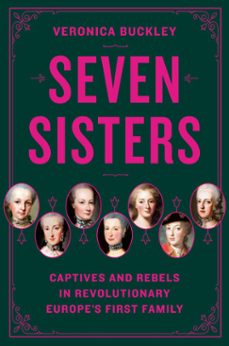
A spirited, poignant history of the seven daughters of the great Empress Maria Theresiaamong them, Queen Marie Antoinette of Francetracing their lives as they balanced dynastic duty with personal ambition in a time of revolutionary cataclysmOthers make war; you, happy Austria, marry.For three centuries, the astute positioning of their many princesses and princes had kept the Habsburgs at the peak of European power. By 1764, after a generation of costly war, confronted by shaken alliances, immense debts, and restive subjects, the Empress Maria Theresia was seeking once again to assert the dynastys power through strategic marriages. Her arsenal was full: her seven daughters were to serve as her pawns in the ruthless game of eighteenth-century dynastic politicking. Delivered to the grandest or dingiest courts in Europe, they made their difficult and even dangerous ways: Marianna the seeker; the grande dame Marie Christine; Elisabeth, the malicious, disfigured beauty; fractious and wayward Amalie of Parma; the tragic bride Josepha; Carolina of Naples, Napoleons relentless enemy; and Antonia, youngest of the seven, sacrificial offering to the gods of revolution, better known to history as Marie Antoinette.Meticulously researched and animated by the sisters own diaries and the almost daily letters traversing the continent, Seven Sisters reveals the drama, tragedy and comedy of these exceptional yet all too human lives. It is a vivid portrait of a brilliant world collapsing in a fearful time.