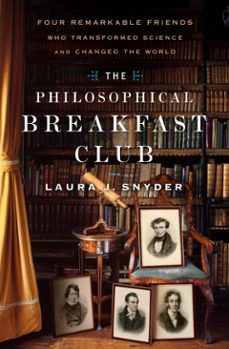
[A] fascinating book...about the way four geniuses at Cambridge University revolutionized modern science. NewsweekThePhilosophical Breakfast Club recounts the life and work of four men who met as students at Cambridge University: Charles Babbage, John Herschel, William Whewell, and Richard Jones. Recognizing that they shared a love of science (as well as good food and drink) they began to meet on Sunday mornings to talk about the state of science in Britain and the world at large. Inspired by the great 17th century scientific reformer and political figure Francis Baconanother former student of Cambridgethe Philosophical Breakfast Club plotted to bring about a new scientific revolution. And to a remarkable extent, they succeeded, even in ways they never intended. Historian of science and philosopher Laura J. Snyderexposes the political passions, religious impulses, friendships, rivalries, and love of knowledgeand powerthat drove these extraordinary men. Whewell (who not only invented the word scientist, but also founded the fields of crystallography, mathematical economics, and the science of tides), Babbage (a mathematical genius who invented the modern computer), Herschel (who mapped the skies of the Southern Hemisphere and contributed to the invention of photography), and Jones (a curate who shaped the science of economics) were at the vanguard of the modernization of science. This absorbing narrative of people, science and ideaschronicles the intellectual revolution inaugurated by these men, one that continues to mold our understanding of the world around us and of our place within it. Drawing upon the voluminous correspondence between the four men over the fifty years of their work, Laura J. Snyder shows how friendship worked to spur the men on to greater accomplishments, and how it enabled them to transform science and help create the modern world."The lives and works of these men come across as fit for Masterpiece Theatre. Wall Street Journal"Snyder succeeds famously in evoking the excitement, variety and wide-open sense of possibility of the scientific life in 19th-century Britain...splendidly evoked in this engaging book. American Scientist"This fine book is as wide-ranging and anecdotal, as excited and exciting, as those long-ago Sunday morning conversations at Cambridge. The Philosophical Breakfast Club forms a natural successor to Jenny Uglows The Lunar Men...and Richard Holmess The Age of Wonder. Washington Post
En el siglo xix, cuatro hombres, tras descubrir en la Universidad de Cambridge su pasión compartida por el progreso científico, deciden reunirse los domingos por la mañana para hablar del estado de la ciencia en Gran Bretaña y en el mundo. Inspirados por el gran politico y reformador cientifico Francis Bacon, los miembros del Club de los desayunos filosoficos aunaron fuerzas para promover una nueva revolucion cientifica. William Whewell, Charles Babbage, John Herschel y Richard Jones, investigadores de prestigio que llevaron a cabo importantes descubrimientos en distintos ambitos, fueron los ultimos filosofos naturales, que no solo estuvieron a la vanguardia de la modernizacion de la ciencia, sino que engendraron una nueva especie: el cientifico. La historiadora Laura J. Snyder explora en este deslumbrante ensayo las motivaciones politicas y religiosas, las amistades y enemistades, y la sed de conocimiento y de poder que impulsaron a estos extraordinarios hombres, protagonistas de una autentica revolucion intelectual.
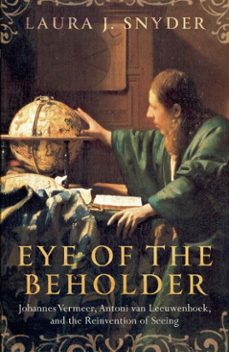
The remarkable story of how an artist and a scientist in seventeenth-century Holland transformed the way we see the world.On a summer day in 1674, in the small Dutch city of Delft, Antoni van Leeuwenhoeka cloth salesman, local bureaucrat, and self-taught natural philosophergazed through a tiny lens set into a brass holder and discovered a never-before imagined world of microscopic life. At the same time, in a nearby attic, the painter Johannes Vermeer was using another optical device, a camera obscura, to experiment with light and create the most luminous pictures ever beheld.In Eye of the Beholder, Laura J. Snyder transports us to the streets, inns, and guildhalls of seventeenth-century Holland, where artists and scientists gathered, and to their studios and laboratories, where they mixed paints and prepared canvases, ground and polished lenses, examined and dissected insects and other animals, and invented the modern notion of seeing. With charm and narrative flair Snyder brings Vermeer and Van Leeuwenhoekand the men and women around themvividly to life. The story of these two geniuses and the transformation they engendered shows us why we see the worldand our place within itas we do today.
En el verano de 1674, en la ciudad de Delft, Antoni van Leeuwenhoek descubrió, mirando a través de una minúscula lente, el mundo microscópico. Al mismo tiempo, en la buhardilla de una casa cercana, Johannes Vermeer empleaba otro instrumento optico—