Steven E. Landsburg es profesor de Economía en la Universidad de Rochester. Es autor de varios libros de éxito en EEUU y de decenas de artículos de revistas de matemáticas, economía y filosofía. Durante más de diez años, escribió una columna semanal en la web Slate, y escribe regularmente en la revista Forbes. También ha colaborado en ocasiones con The New York Times, The Wall Street Journal y The Washington Post y ha participado como comentarista en diferentes programas radiofónicos.
Recibe novedades de Steven E. Landsburg directamente en tu email

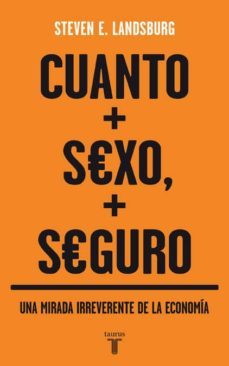
Este libro es la prueba de que la economía no es necesariamente una ciencia deprimente. Bien al contrario, Steven Landsburg es capaz de convertirla en algo no sólo divertido sino también fascinante, ya que busca las razones que explican los hechos mas curiosos de nuestra vida cotidiana. En Cuanto mas sexo, mas seguro aplica un ingenioso analisis en terminos economicos a nuestras decisiones cotidianas e individuales, y demuestra como estas estan estrechamente relacionadas con ciertas respuestas colectivas realmente sorprendentes. ¿Sabias que la gente podria estar aumentando la propagacion de enfermedades de transmision sexual precisamente al evitar practicar sexo ocasional? ¿Sabias que la gente alta gana mas dinero que la baja? ¿Sabias que no tiene sentido hacer donaciones a mas de una organizacion caritativa? ¿Por que los padres de hijos varones permanecen casados mas tiempo que los padres de hijas? A todas estas polemicas cuestiones, Landsburg ofrece argumentos y soluciones que van contra toda intuicion y estan, sin embargo, basados en la logica. La leccion de este fascinante, entretenido y provocador libro es doble: muchos comportamientos aparentemente extraños tienen explicaciones logicas, mientras que otros, aparentemente logicos, no tienen ningun sentido.
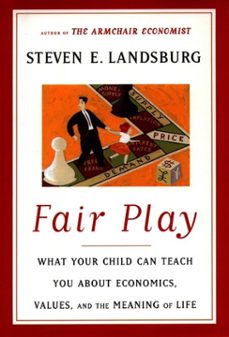
With his witty and instructive book The Armchair Economist, Steven Landsburg won popularity and acclaim by using economics to illuminate the mysteries of daily life, and using daily life to illuminate the mysteries of economics.Now Landsburg returns to address fundamental issues like fairness, tolerance, morality and justiceissues that are as important on the playground as they are in the marketplace. With the help of his daughter, Cayley, he contrasts the wisdom of parents with the wisdom of economistsnot always to the credit of the latter.How should we feel about taxes that redistribute income? Ask how parents feel about children who forcibly "redistribute" other childrens toys. How should we respond to those who complain that their neighbors are too wealthy? Ask how parents respond when children complain that their siblings got too much cake. By insisting that fairness cant mean one thing for children and another for adults, Landsburg shows that the instincts of the parent have profound consequences for economic justice.Along the way, Landsburgwith his customary sharp wit and challenging logicpauses to reflect on an astonishing variety of issues in economic theory, the philosophy of parenting, the true nature of family values, and how to get the most out of life. He uses parent-child interactions to explain the economics of free trade and immigration, progressive taxation, minimum wages, racial discrimination, and the role of money. He makes the best possible philosophical cases for and against progressive taxation, and weighs them against the wisdom of the playground. He explains why children are a good thing, and why economic theory tells us we dont have enough of them. He meditates on the role of authority in our lives, the effects of cultural bias, and why its important to read poetry to your children. This lively and entertaining book will inform and delight readers who have forgotten the human side of the dismal science.
In the wake of his enormously popular books The Armchair Economist and More Sex Is Safer Sex, Steven Landsburg uses concepts from mathematics, economics, and physics to address the big questions in philosophy: What is real? What can we know? What is the difference between right and wrong? And how should we live?Widely renowned for his lively explorations of economics, in his fourth book Landsburg branches out into mathematics and physics as welldisciplines that, like economics, the author loves for their beauty, their logical clarity, and their profound and indisputable truthto take us on a provocative and utterly entertaining journey through the questions that have preoccupied philosophers through the ages. The author begins with the broadest possible categoriesReality and Unreality; Knowledge and Belief; Right and Wrongand then focuses his exploration on specific concerns: from a mathematical analysis of the arguments for the existence of God; to the real meaning of the Heisenberg Uncertainty Principle and the Godel Incompleteness Theorem; to the moral choices we face in the marketplace and the voting booth. Stimulating, illuminating, and always surprising, The Big Questions challenges readers to re-evaluate their most fundamental beliefs and reveals the relationship between the loftiest philosophical quests and our everyday lives.
Este libro convierte la microeconomía intermedia en algo atractivo y en un reto intelectual. El estilo constituye una presentación rica en aplicaciones, combinada con desarrollo cuidadoso de la teoría microeconomica; ademas, incluye temas habituales de la teoria, lo mismo que aspectos innovadores. Se ilustran en todo el texto las relaciones entre microeconomia y macroeconomia. Algunos aspectos puramente micro se ilustran con aplicaciones macro, como informacion, toma de decisiones intemporal, mercados laborales en equilibrio general y expectativas racionales. El ultimo capitulo describe el analisis economico con ejemplos tomados de la sociologia, la biologia y la historia, con lo que se ilustra una vision de la microeconomia en la que confluyen varias disciplinas.
A witty and razor-sharp look at the many ways our individually rational decisions can combine into some truly weird collective resultsand some hilarious and serious ways to fix just about everything.Economics is no longer the dismal science dreaded by college freshmen. In recent years, a band of economists has broken away from the charts and graphs of college textbooks, and begun to explain ordinary behavior in plain and often entertaining English. Steve Landsburg was one of the first of the new breed, in his book The Armchair Economist and long-running Everyday Economics column in Slate magazine. Now he is back, and more provocative than ever.In More Sex Is Safer Sex, Landsburg shows how the rational behavior of each one of uswhen combined togetherproduces the often bizarre, seemingly irrational behavior of crowds. We all stand up at the ballpark, so none of us can see. We avoid casual sex, from fear of disease, and we thereby make sex more dangerous. Things really get interesting when Landsburg suggests ways to change the rules, and game the system. Why not charge juries if a convicted felon is exonerated? Why not have each member of Congress represent a national subset of voters, chosen alphabetically? Why not solve the overpopulation problem by having more children, who will help think of ways to improve our use of resources?More Sex Is Safer Sex will make you laugh and argueand it will make you think about the world around you in new and unforgettable ways.
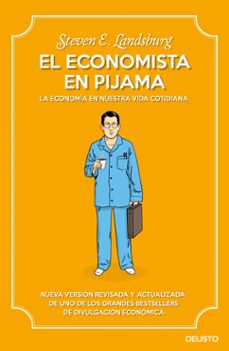
¿Por qué las palomitas son tan caras en el cine? Aunque parezca mentira, la resolución de esta pregunta es uno de los problemas recurrentes que se plantean en economía. Y es que la respuesta obvia es equivocada. Lo logico seria contestar que el propietario tiene el monopolio y por eso puede aumentar el precio, pero si esa fuera la respuesta acertada tambien podria fijar un precio para usar el lavabo y no lo hace. Algo que a primera vista parece muy facil de contestar se convierte en un misterio que la teoria economica nos ayuda a entender.En esta edicion revisada y actualizada del clasico El economista en pijama, Steven E. Landsburg explica, con un lenguaje coloquial y divertido, este y otros casos con los que nos encontramos habitualmente.