































eBook INGLÉS EPUB sin DRM
Principia
"The Mathematical Principles of Natural Philosophy"
Por Isaac Newton
-5% de dto. exclusivo web
Sinopsis
Philosophiæ Naturalis Principia Mathematica (Latin for Mathematical Principles of Natural Philosophy), often referred to as simply the Principia, is a work in three books by Isaac Newton, in Latin, first published 5 July 1687. After annotating and correcting his personal copy of the first edition, Newton published two further editions, in 1713 and 1726. The Principia states Newtons laws of motion, forming the foundation of classical mechanics; Newtons law of universal gravitation; and a derivation of Keplers laws of planetary motion (which Kepler first obtained empirically).
The Principia is considered one of the most important works in the history of science. The French mathematical physicist Alexis Clairaut assessed it in 1747: "The famous book of Mathematical Principles of Natural Philosophy marked the epoch of a great revolution in physics. The method followed by its illustrious author Sir Newton ... spread the light of mathematics on a science which up to then had remained in the darkness of conjectures and hypotheses."
A more recent assessment has been that while acceptance of Newtons theories was not immediate, by the end of the century after publication in 1687, "no one could deny that" (out of the Principia) "a science had emerged that, at least in certain respects, so far exceeded anything that had ever gone before that it stood alone as the ultimate exemplar of science generally".
In formulating his physical theories, Newton developed and used mathematical methods now included in the field of Calculus. But the language of calculus as we know it was largely absent from the Principia; Newton gave many of his proofs in a geometric form of infinitesimal calculus, based on limits of ratios of vanishing small geometric quantities. In a revised conclusion to the Principia (see General Scholium), Newton used his expression that became famous.
The Principia deals primarily with massive bodies in motion, initially under a variety of conditions and hypothetical laws of force in both non-resisting and resisting media, thus offering criteria to decide, by observations, which laws of force are operating in phenomena that may be observed. It attempts to cover hypothetical or possible motions both of celestial bodies and of terrestrial projectiles. It explores difficult problems of motions perturbed by multiple attractive forces. Its third and final book deals with the interpretation of observations about the movements of planets and their satellites.
It shows:
• How astronomical observations prove the inverse square law of gravitation (to an accuracy that was high by the standards of Newtons time);
• Offers estimates of relative masses for the known giant planets and for the Earth and the Sun;
• Defines the very slow motion of the Sun relative to the solar-system barycenter;
• Shows how the theory of gravity can account for irregularities in the motion of the Moon;
• Identifies the oblateness of the figure of the Earth;
• Accounts approximately for marine tides including phenomena of spring and neap tides by the perturbing (and varying) gravitational attractions of the Sun and Moon on the Earths waters;
• Explains the precession of the equinoxes as an effect of the gravitational attraction of the Moon on the Earths equatorial bulge; and
• Gives theoretical basis for numerous phenomena about comets and their elongated, near-parabolic orbits.
The Principia is considered one of the most important works in the history of science. The French mathematical physicist Alexis Clairaut assessed it in 1747: "The famous book of Mathematical Principles of Natural Philosophy marked the epoch of a great revolution in physics. The method followed by its illustrious author Sir Newton ... spread the light of mathematics on a science which up to then had remained in the darkness of conjectures and hypotheses."
A more recent assessment has been that while acceptance of Newtons theories was not immediate, by the end of the century after publication in 1687, "no one could deny that" (out of the Principia) "a science had emerged that, at least in certain respects, so far exceeded anything that had ever gone before that it stood alone as the ultimate exemplar of science generally".
In formulating his physical theories, Newton developed and used mathematical methods now included in the field of Calculus. But the language of calculus as we know it was largely absent from the Principia; Newton gave many of his proofs in a geometric form of infinitesimal calculus, based on limits of ratios of vanishing small geometric quantities. In a revised conclusion to the Principia (see General Scholium), Newton used his expression that became famous.
The Principia deals primarily with massive bodies in motion, initially under a variety of conditions and hypothetical laws of force in both non-resisting and resisting media, thus offering criteria to decide, by observations, which laws of force are operating in phenomena that may be observed. It attempts to cover hypothetical or possible motions both of celestial bodies and of terrestrial projectiles. It explores difficult problems of motions perturbed by multiple attractive forces. Its third and final book deals with the interpretation of observations about the movements of planets and their satellites.
It shows:
• How astronomical observations prove the inverse square law of gravitation (to an accuracy that was high by the standards of Newtons time);
• Offers estimates of relative masses for the known giant planets and for the Earth and the Sun;
• Defines the very slow motion of the Sun relative to the solar-system barycenter;
• Shows how the theory of gravity can account for irregularities in the motion of the Moon;
• Identifies the oblateness of the figure of the Earth;
• Accounts approximately for marine tides including phenomena of spring and neap tides by the perturbing (and varying) gravitational attractions of the Sun and Moon on the Earths waters;
• Explains the precession of the equinoxes as an effect of the gravitational attraction of the Moon on the Earths equatorial bulge; and
• Gives theoretical basis for numerous phenomena about comets and their elongated, near-parabolic orbits.

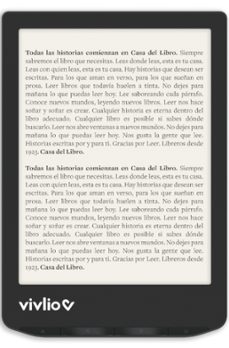
-15€ en eReader Vivlio Light Zen*
Este verano lee sin parar. Del 13 de julio al 2 de agosto llévate nuestro eReader Vivlio Light Zen por solo 94,99€ (-15 € de descuento).
Léelo en cualquier dispositivo


Ficha Técnica
Editorial: E-kitap Projesi & Cheapest Books
ISBN: 9786257959575
Idioma: Inglés
Fecha de lanzamiento: 21/12/2023
Especificaciones del producto

Recibe novedades de Isaac Newton directamente en tu email
Reseñas sobre Principia
Comparte tu experiencia con la comunidad lectora.
0 Reseñas
5 0
4 0
3 0
2 0
1 0
Sólo por opinar entras en el sorteo mensual de tres tarjetas regalo valoradas en
20€
Publicar una opinión supone haber leído y aceptado las
bases del sorteo
"Tu opinión tiene premio".







*Descuento de 15 euros en el eReader Vivlio Light Zen, válido para pedidos realizados en casadellibro.com del 13 de julio al 2 de agosto y solo para los 300 primeros compradores, hasta fin de existencias.