Throughout history, financial crises have always been caused by excesses--frequently monetary excesses--which lead to a boom and an inevitable bust. In our current crisis it was a housing boom and bust that in turn led to financial turmoil in the United States and other countries. How did everything deteriorate so suddenly and dramatically? In Getting Off Track: How Government Actions and Interventions Caused, Prolonged, and Worsened the Financial Crisis, Hoover fellow and Stanford economist John B. Taylor offers empirical research to explain what caused the current financial crisis, what prolonged it, and what worsened it dramatically more than a year after it began. The author tells how unusually easy monetary policy helped set the crisis in motion, as interest rates at the Federal Reserve and several other central banks deviated from historical regularities. He explains monetary interaction with the subprime mortgage problem, showing how the use of these mortgages, especially the adjustable-rate variety, led to excessive risk taking. In the United States this was encouraged by government programs designed to promote home ownership, a worthwhile goal but overdone in retrospect. Looking ahead, the author suggests a set of principles to follow to prevent misguided actions and interventions in the future
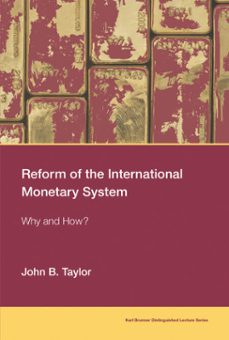
An argument that a rules-based reform of the international monetary system, achieved by applying basic economic theory, would improve economic performance.In this book, the economist John Taylor argues that the apparent correlation of monetary policy decisions among different countrieslargely the result of countries concerns about the exchange ratecauses monetary policy to deviate from effective policies that stabilize inflation and the economy. He argues that a rules-based reform of the international monetary system, achieved by applying basic economic theory, would improve economic performance.Taylor shows that monetary polices in recent years have been deployed either defensively, as central banks counteract forces from abroad that affect the exchange rate, or offensively, as central banks attempt to move the exchange rate to gain a competitive advantage. Focusing on the years from 2005 to 2017, he develops an empirical framework to examine two monetary policy instruments: the policy interest rate (the more conventional of the two) and the size of the balance sheet. He finds that an international contagion in central bank decisions about the policy interest rate has accentuated the deviation from standard interest rate rules that have worked in the past. He finds a similar contagion in decisions about the size of the balance sheet. By considering a counterfactual policy in the estimated model, Taylor is able to estimate by how much the policy of recent years has increased exchange rate volatility. After several rounds of monetary actions and reactions aimed at exchange rates, Taylor finds, the international monetary system is left with roughly the same interest rate configuration, but much larger balance sheets to unwind.
Prólogo de Pedro Schwartz. ¿Por qué se produjo la crisis financiera? ¿Por qué se prolongó? ¿Por qué empeoró drásticamente más de un año después de haber comenzado? Estas tres preguntas encuentran respuestas claras, concisas y contundentes en Sin rumbo. En este libro, John B. Taylor creador de la conocida regla de Taylor de la Teoria Monetaria expone de forma amena y sencilla por que las actuaciones y las intervenciones publicas se han ganado en esta crisis el dudoso honor de figurar en los primeros puestos de la lista de culpables.
Psiquiatría de bolsillo es una de las adiciones más recientes a la colección De bolsillo; su contenido ha sido desarrollado por psiquiatras en formación y está dirigido a los estudiantes de medicina y a los profesionales de la salud que deseen conocer las bases del diagnostico y tratamiento de las enfermedades y condiciones mentales mas comunes. Al igual que otros titulos de la coleccion, Psiquiatria de bolsillo posee una estructura amigable que facilita la lectura y la retencion del conocimiento y conceptos complejos. Su contenido hace enfasis en la atencion psiquiatrica basada en la evidencia, desde el encuentro inicial con el paciente y su entrevista hasta el diagnostico y plan de tratamiento. La obra se compone de nueve secciones que exploran los fundamentos de la evaluacion psiquiatrica, la atencion de todos los trastornos psiquiatricos principales, las diferentes opciones de terapeutica y la atencion de emergencias psiquiatricas y de grupos especiales.