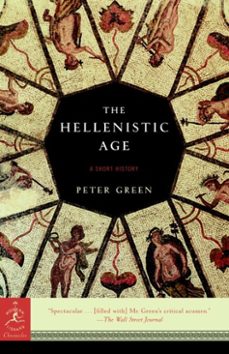
The Hellenistic era witnessed the overlap of antiquitys two great Western civilizations, the Greek and the Roman. This was the epoch of Alexanders vast expansion of the Greco-Macedonian world, the rise and fall of his successors major dynasties in Egypt and Asia, and, ultimately, the establishment of Rome as the first Mediterranean superpower.The Hellenistic Age chronicles the years 336 to 30 BCE, from the days of Philip and Alexander of Macedon to the death of Cleopatra and the final triumph of Caesars heir, the young Augustus. Peter Greens remarkably far-ranging study covers the prevalent themes and events of those centuries: the Hellenization of an immense swath of the known worldfrom Egypt to Indiaby Alexanders conquests; the lengthy and chaotic partition of this empire by rival Macedonian marshals after Alexanders death; the decline of thepolis (city state) as the predominant political institution; and, finally, Romes moment of transition from republican to imperial rule.Predictably, this is a story of war and power-politics, and of the developing fortunes of art, science, and statecraft in the areas where Alexanders coming disseminated Hellenic culture. It is a rich narrative tapestry of warlords, libertines, philosophers, courtesans and courtiers, dramatists, historians, scientists, merchants, mercenaries, and provocateurs of every stripe, spun by an accomplished classicist with an uncanny knack for infusing life into the distant past, and applying fresh insights that make ancient history seem alarmingly relevant to our own times.To consider the three centuries prior to the dawn of the common era in a single short volume demands a scholar with a great command of both subject and narrative line. The Hellenistic Age is that rare book that manages to coalesce a broad spectrum of events, persons, and themes into one brief, indispensable, and amazingly accessible survey.
Ver más