Shing-Tung Yau es profesor de Matemáticas en Harvard desde 1987. Ganador de la Medalla Fields, la Medalla Nacional de Ciencia, el Premio Wolf, entre otros. Miembro de la Academia Nacional de Ciencias, ha recibido diez doctorados honoris causa. Dirige seis institutos matemáticos en China y Hong Kong, ha escrito más de veinte libros y reside en Cambridge.
Recibe novedades de Shing-Tung Yau directamente en tu email

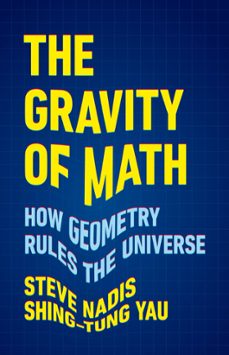
"A must-read.Avi Loeb, New York Timesbestselling author of Extraterrestrial One of the preeminent mathematicians of the past half century shows how physics and math were combined to give us the theory of gravity and the dizzying array of ideas and insights that has come from it Mathematics is far more than just the language of science. It is a critical underpinning of nature. The famed physicist Albert Einstein demonstrated this in 1915 when he showed that gravitylong considered an attractive force between massive objectswas actually a manifestation of the curvature, or geometry, of space and time. But in making this towering intellectual leap, Einstein needed the help of several mathematicians, including Marcel Grossmann, who introduced him to the geometrical framework upon which his theory rest. In The Gravity of Math, Steve Nadis and Shing-Tung Yau consider how math can drive and sometimes even anticipate discoveries in physics. Examining phenomena like black holes, gravitational waves, and the Big Bang, Nadis and Yau ask: Why do mathematical statements, derived solely from logic, provide the best descriptions of our physical world? The Gravity of Math offers an insightful and compelling look into the power of mathematicswhose reach, like that of gravity, can extend to the edge of the universe.
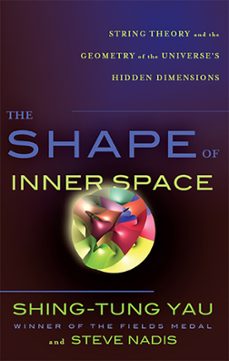
String theory says we live in a ten-dimensional universe, but that only four are accessible to our everyday senses. According to theorists, the missing six are curled up in bizarre structures known as Calabi-Yau manifolds. In The Shape of Inner Space, Shing-Tung Yau, the man who mathematically proved that these manifolds exist, argues that not only is geometry fundamental to string theory, it is also fundamental to the very nature of our universe. Time and again, where Yau has gone, physics has followed. Now for the first time, readers will follow Yaus penetrating thinking on where weve been, and where mathematics will take us next. A fascinating exploration of a world we are only just beginning to grasp, The Shape of Inner Space will change the way we consider the universe on both its grandest and smallest scales.
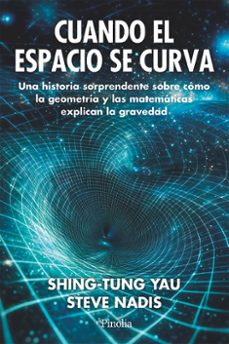
En las páginas de esta obra magistral, Nadis y Yau desvelan el vínculo profundo que une las matemáticas con la gravedad y nos muestran que las estructuras matemáticas no son simples herramientas para describir la naturaleza, sino parte intrinseca de su tejido fundamental.A traves de un fascinante recorrido historico, los autores esclarecen como el pensamiento matematico ha transformado nuestra comprension del cosmos. El caso emblematico de Einstein ilustra esta simbiosis: en 1915, con el apoyo crucial del matematico Marcel Grossmann, Einstein revoluciono la fisica cuando redefinio la gravedad no como una fuerza de atraccion entre masas, sino como una manifestacion de la curvatura del espaciotiempo. Este giro conceptual, que Nadis y Yau explican con elegancia y rigor, marco el comienzo de una nueva era en nuestra concepcion del universo.La potencia de esta vision geometrica de la gravedad abrio horizontes antes insospechados. Fenomenos como los agujeros negros, las ondas gravitacionales o el Big Bang encontraron primero su explicacion en el lenguaje abstracto de las ecuaciones, para despues confirmarse mediante observaciones experimentales. Esta extraordinaria capacidad predictiva nos lleva a una cuestion fascinante: ¿como es posible que estructuras matematicas concebidas por la mente humana puedan anticipar con tal precision propiedades del mundo fisico aun por descubrir?Sin renunciar al rigor cientifico pero con un lenguaje accesible, Cuando el espacio se curva nos ofrece un viaje intelectual en el que cada formula revela un aspecto oculto de la realidad. En sus paginas, los autores demuestran que la elegancia matematica y la arquitectura cosmica comparten una misteriosa y profunda afinidad que no deja de asombrar incluso a los cientificos mas experimentados.