































A Small Matter of Programming asks why it has been so difficult for end users to command programming power and explores the problems of end user-driven application development that must be solved to afford end users greater computational power. Drawing on empirical research on existing end user systems, A Small Matter of Programming analyzes cognitive, social, and technical issues of end user programming. In particular, it examines the importance of task-specific programming languages, visual application frameworks, and collaborative work practices for end user computing, with the goal of helping designers and programmers understand and better satisfy the needs of end users who want the capability to create, customize, and extend their applications software. The ideas in the book are based on the authors research on two successful end user programming systems - spreadsheets and CAD systems - as well as other empirical research. Nardi concentrates on broad issues in end user programming, especially end users strengths and problems, introducing tools and techniques as they are related to higher-level user issues. Bonnie A. Nardi is a Member of the Technical Staff at Hewlett Packard Laboratories.
A systematic presentation of activity theory, its application to interaction design, and an argument for the development of activity theory as a basis for understanding how people interact with technology.Activity theory holds that the human mind is the product of our interaction with people and artifacts in the context of everyday activity. Acting with Technology makes the case for activity theory as a basis for understanding our relationship with technology. Victor Kaptelinin and Bonnie Nardi describe activity theorys principles, history, relationship to other theoretical approaches, and application to the analysis and design of technologies. The book provides the first systematic entry-level introduction to the major principles of activity theory. It describes the accumulating body of work in interaction design informed by activity theory, drawing on work from an international community of scholars and designers. Kaptelinin and Nardi examine the notion of the object of activity, describe its use in an empirical study, and discuss key debates in the development of activity theory. Finally, they outline current and future issues in activity theory, providing a comparative analysis of the theory and its leading theoretical competitors within interaction design: distributed cognition, actor-network theory, and phenomenologically inspired approaches.
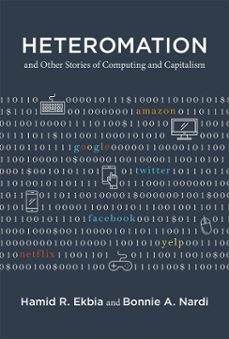
An exploration of a new division of labor between machines and humans, in which people provide value to the economy with little or no compensation.The computerization of the economyand everyday lifehas transformed the division of labor between humans and machines, shifting many people into work that is hidden, poorly compensated, or accepted as part of being a user of digital technology. Through our clicks and swipes, logins and profiles, emails and posts, we are, more or less willingly, participating in digital activities that yield economic value to others but little or no return to us. Hamid Ekbia and Bonnie Nardi call this kind of participationthe extraction of economic value from low-cost or free labor in computer-mediated networksheteromation. In this book, they explore the social and technological processes through which economic value is extracted from digitally mediated work, the nature of the value created, and what prompts people to participate in the process.Arguing that heteromation is a new logic of capital accumulation, Ekbia and Nardi consider different kinds of heteromated labor: communicative labor, seen in user-generated content on social media; cognitive labor, including microwork and self-service; creative labor, from gaming environments to literary productions; emotional labor, often hidden within paid jobs; and organizing labor, made up of collaborative groups such as citizen scientists. Ekbia and Nardi then offer a utopian vision: heteromation refigured to bring end users more fully into the prosperity of capitalism.